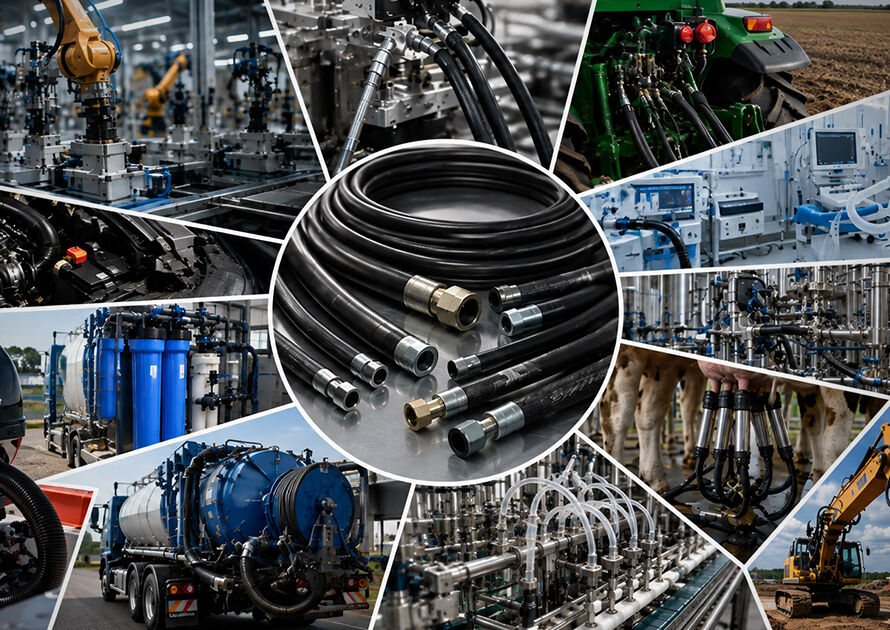
Industrial operations rely on durable, high-performance hose systems to move liquids, gases, chemicals, steam, and abrasive materials safely and efficiently. Whether used in manufacturing, agriculture, food processing, marine operations, or chemical plants, an industrial rubber hose plays a critical role in maintaining productivity, protecting equipment, and supporting safe day-to-day operations.
Choosing the right industrial hose is more than matching the correct size or pressure rating. Factors such as the type of material being transferred, operating temperature, chemical compatibility, environmental conditions, flexibility, and fittings all influence hose performance. Using the wrong hose can lead to leaks, premature wear, equipment failure, product contamination, workplace safety hazards, and costly downtime. It can also increase maintenance requirements and shorten the service life of both the hose and the connected equipment.
With a wide range of hose materials, reinforcement options, and designs available, selecting the best solution can seem complex. Understanding how hoses are constructed, where different materials perform best, and how each design supports a specific application can help end users make informed decisions that improve reliability and reduce long-term operating costs.
This guide explains everything you need to know about types of hoses, including their construction, common rubber compounds, industry-specific applications, key selection criteria, maintenance best practices, and when custom rubber hoses may offer the best solution for demanding operating environments.
What Is an Industrial Rubber Hose?
An industrial rubber hose is a flexible, engineered product designed to safely transfer liquids, gases, steam, chemicals, abrasive materials, and food products across a wide range of industrial environments. Unlike standard hoses, it is built to withstand demanding operating conditions, taking in every relevant service condition while delivering reliable performance.
Compared to other hose types, industrial rubber hoses offer distinct advantages:
- Garden hoses: Designed for light residential use and low-pressure applications.
- PVC hoses: Lightweight and economical but generally less durable in extreme temperatures or harsh industrial environments.
- Metal hoses: Suitable for many high-temperature applications but heavier, less flexible, and often more expensive.
- Rubber hoses: Provide an excellent balance of flexibility, durability, pressure resistance, and medium compatibility, making them ideal for most industrial applications.
One of the key benefits of rubber hose materials is their ability to resist abrasion, weathering, chemicals, and temperature fluctuations while maintaining the flexibility needed for efficient installation and operation, whether a straight line or a challenging offset installation.
Industrial rubber hoses are manufactured in various diameters, pressure ratings, lengths, and material compositions to meet specific operating requirements. Every industrial hose is engineered based on the media it will carry, whether it is water, chemicals, oil, steam, food products, or abrasive materials. Selecting the right hose ensures safe operation, improved performance, and longer service life – proving true value.
For applications that require specialized designs or unique performance characteristics, custom rubber hoses can be engineered to meet exact operating conditions, where a one-size-fits-all commodity hose is often a short-term solution with less long-term value.
How Industrial Rubber Hoses Are Constructed
The performance of an industrial rubber hose depends on how its three main layers work together. Each layer serves a specific purpose, from safely carrying the media to handling pressure or vacuum and protecting the hose from external conditions.
Inner Tube
The inner tube is the innermost layer that comes into direct contact with the material being conveyed. Its composition must be compatible with the media at temperature to ensure safe and reliable operation.
Choosing the wrong inner tube material can lead to:
- Swelling or cracking
- Chemical degradation and rupture
- Product contamination
- Excess wear
- Premature hose failure
Depending on the industrial hose application, the inner tube may be designed to provide:
- Oil resistance
- Chemical resistance
- Food-grade compliance
- Heat resistance
- Abrasion and wear resistance
Reinforcement Layer
The reinforcement layer gives the hose its strength and determines how much pressure it can safely handle. The type of reinforcement is selected based on the application’s operating conditions.
Common reinforcement types include:
- Textile braided reinforcement
- Textile spiral reinforcement
- Steel wire braid
- Steel wire spiral
A properly engineered reinforcement layer helps provide:
- Appropriate working pressure
- Adequate burst pressure
- Kink resistance
- The right balance between flexibility and strength
A wire helix can add to the hose’s working pressure, improve bend radius, and prevent collapse from vacuum.
Outer Cover
The outer cover protects the hose from environmental and mechanical damage, helping extend its service life in demanding industrial settings.
Depending on the operating environment, the cover may be designed to resist:
- UV exposure
- Weathering
- Abrasion
- Oils
- Chemicals
- Ozone
- Cuts and tears
The right combination of inner tube, reinforcement, and outer cover ensures the hose performs safely and reliably throughout its intended service life. Manufacturers with expertise in custom rubber hose manufacturing can tailor each layer to meet the specific demands of an application.
Types of Industrial Rubber Hoses
Different types of industrial hoses are designed to perform specific functions. Selecting the right hose depends on the material being conveyed, operating pressure, vacuum, temperature, and the demands of the application.
Suction & Discharge (S&D) Hoses
Purpose: Used to transfer large volumes of liquids, slurries, and abrasive materials.
These large-bore hoses are reinforced to withstand both positive pressure and vacuum conditions, making them suitable for demanding material transfer operations and dock hoses.
Common applications:
- Dredging and marine dock transfer
- Wastewater and vacuum trucks
- Mining and slurry handling
- General Material Handling
Air & Water Hoses
Purpose: Built for general-purpose air and water transfer in industrial environments.
These hoses are generally more lightweight, flexible, and durable enough for everyday operations where high-pressure fluid transfer is not required.
Common applications:
- Equipment wash-down
- Irrigation systems
- Vapor Recovery
- Heat Exchange
Steam Hoses
Purpose: Engineered to safely transfer saturated or superheated steam.
Steam hoses are constructed with heat-resistant compounds and specialized reinforcement to withstand elevated temperatures and pressure. Proper installation and routine inspection are essential for safe operation.
Common applications:
- Steam cleaning
- Industrial processing
- Chemical and manufacturing facilities
Chemical Transfer Hoses
Purpose: Designed to safely convey aggressive chemicals and hazardous fluids.
These hoses feature chemically resistant inner liners selected to withstand acids, alkalis, solvents, and other corrosive substances while minimizing the risk of contamination.
Common applications:
- Chemical processing plants
- Petrochemical facilities
- Bulk chemical transfer
- Oil Transfer
Food-Grade / Sanitary Hoses
Purpose: Used to transfer food, beverages, dairy products, and other sanitary materials.
Manufactured with food-safe rubber hose materials, these hoses are designed to meet applicable FDA and sanitary requirements while preserving product quality.
Common applications:
- Dairy processing
- Beverage production
- Bulk food and powder transfer
Home Rubber also manufactures food-grade hoses for applications where hygiene, product integrity, and regulatory compliance are critical.
Custom & Hand-Built Hoses
Purpose: Designed for applications where standard hose configurations cannot meet operational requirements.
Custom rubber hoses can be manufactured with specialized diameters, lengths, reinforcement, end connections, and material combinations to address unique operating conditions.
Common applications:
- OEM equipment
- Marine and dock operations
- Specialized industrial processing
For complex or highly demanding applications, hand-built custom hoses can be engineered to meet precise performance specifications.
Common Rubber Materials Used in Industrial Hoses
| Rubber Material | Temperature Range | Oil Resistance | Chemical Resistance | Abrasion Resistance | Flexibility | Typical Applications |
|---|---|---|---|---|---|---|
| Natural Rubber (NR) | Moderate | Low | Fair | Excellent | Excellent | Water transfer, slurry handling, mining |
| EPDM | Excellent | Poor | Excellent (water, steam, mild chemicals) | Good | Excellent | Steam, hot water, outdoor and irrigation applications |
| Nitrile (NBR) | Good | Excellent | Good | Good | Good | Petroleum products, oils, fuels, hydraulic fluids |
| Neoprene (CR) | Good | Good | Good | Good | Good | Marine, industrial air, weather-exposed applications |
| Silicone | Excellent | Fair | Good | Fair | Excellent | Food processing, pharmaceuticals, high-temperature transfer |
| Butyl | Excellent | Poor | Excellent | Good | Good | Chemical processing, compressed air, hot water |
| SBR (Styrene-Butadiene Rubber) | Moderate | Poor | Fair | Good | Good | General-purpose air and water hoses |
| Viton® (FKM) | Outstanding | Excellent | Excellent | Good | Moderate | Aggressive chemicals, solvents, high-temperature industrial processes |
The performance of an industrial rubber hose depends heavily on the rubber compound used in its construction. Different rubber hose materials offer varying levels of resistance to heat, chemicals, oils, abrasion, and weathering. Because no single material performs best in every environment, selecting the right compound is essential for maximizing hose performance and service life.
Need to insert a table. How do I do that?
The best material depends on the intended industrial hose application. For example, Nitrile is commonly selected for oil and fuel transfer, while EPDM performs well in steam and hot water applications. Food-grade processes may require silicone or other FDA-compliant compounds, whereas highly corrosive chemicals often demand premium materials such as an FKM like Viton.
When selecting an industrial hose, it is important to evaluate operating temperature, media compatibility, pressure requirements, and environmental conditions together rather than focusing on a single performance requirement. This ensures that the hose can deliver safe, reliable performance throughout its service life.
Common Applications of Industrial Rubber Hoses by Industry
Industrial rubber hoses are essential to operations across a wide range of industries. While the materials being conveyed vary, every industrial hose application requires a hose that is compatible with the media, operating conditions, and environmental challenges.
Manufacturing
Manufacturing facilities rely on industrial rubber hoses to keep production lines running efficiently. They are commonly used to transfer compressed air, coolants, water, hydraulic fluids, and process materials.
Typical requirements:
- Pressure resistance
- Flexibility for equipment movement
- Abrasion and oil resistance
Agriculture
In agriculture, hoses support irrigation, crop protection, and equipment operation by transferring water, fertilizers, pesticides, and slurry.
Typical requirements:
- Weather and UV resistance
- Flexibility for outdoor use
- Resistance to fertilizers and agricultural chemicals
Mining
Mining operations place extreme demands on hoses due to abrasive materials and harsh environments. Hoses are used to transport slurry, water, tailings, and for dust suppression.
Typical requirements:
- High abrasion resistance
- Heavy-duty reinforcement
- Reliable performance under demanding conditions
Food Processing
Food and beverage facilities require sanitary and FDA-approved hoses that safely transfer dairy products, beverages, edible oils, bulk powders, and other food ingredients without compromising product quality.
Typical requirements:
- Food-grade materials
- Easy cleaning and sanitation
- Extraction traceability
- Compliance with applicable food safety standards
For hygienic transfer applications, food-grade hoses are designed to help maintain product integrity throughout the process.
Chemical Processing
Chemical plants depend on specialized hoses to safely convey acids, alkalis, solvents, and other corrosive chemicals. Material compatibility is critical to prevent degradation and contamination.
Typical requirements:
- Excellent chemical resistance
- Pressure and temperature capability
- Long-term durability in aggressive environments
Oil & Gas
The oil and gas industry uses industrial hoses for transferring fuels, petroleum products, drilling fluids, and lubricants in both upstream and downstream operations.
Typical requirements:
- Oil-resistant compounds
- High-pressure performance
- Reliable sealing and durability
- U.S. Coast Guard Certification
Marine
Marine operations require hoses capable of handling seawater, fuel, and dockside transfer applications while withstanding constant exposure to harsh environmental conditions.
Typical requirements:
- Weather and ozone resistance
- Fuel Resistance
- Flexibility for dock and vessel operations
Home Rubber serves a variety of marine and industrial markets with hose solutions engineered for demanding environments.
Construction
Construction sites use hoses for concrete pumping, water supply, pneumatic equipment, and dust suppression. These applications often involve rough handling and challenging job site conditions.
Typical requirements:
- Abrasion resistance
- Flexibility
- High durability for outdoor use
Municipal Utilities
Municipal utility operations rely on hoses for potable water distribution, wastewater management, sewage handling, and routine maintenance activities.
Typical requirements:
- Reliable pressure performance
- Resistance to weather and chemicals (Chloramine and Chlorine)
- Long service life in continuous-duty applications
Across all industries, selecting the appropriate rubber hose ensures safer operation, improved efficiency, and reduced maintenance costs
How to Choose the Right Industrial Rubber Hose
Selecting the right industrial rubber hose involves more than matching a hose to the material being transferred. A practical way to evaluate your requirements is the STAMPED method, which helps ensure the hose is suited to its operating environment and delivers reliable performance over time. The STAMPED acronym is below:
S – Size
Choose the correct inside diameter (ID), outside diameter (OD), and hose length for your application. An undersized hose can restrict flow and increase pressure loss, while an oversized hose may reduce efficiency and make installation more difficult.
Example: A production line requiring high flow rates may need a larger ID to maintain consistent throughput.
T – Temperature
Consider both the temperature of the media flowing through the hose and the surrounding ambient conditions. A hose must perform reliably across the full operating temperature range without losing flexibility or degrading.
Example: A hose carrying hot steam outdoors must withstand both elevated operating temperatures and changing weather conditions.
A – Application
Think about how the hose will be used. Will it handle suction or discharge? Will it remain stationary or flex continuously? Is it hanging or lying on the ground? How much will it bend? Will it operate indoors or be exposed to sunlight, moisture, or abrasive surfaces?
Example: A slurry transfer hose used in mining requires a different construction than an air hose used inside a manufacturing facility, and a stiff hose may not be able to make a 90-degree bend to reach the connecting pipe
M – Media
Identify exactly what will flow through the hose. The rubber hose materials used for the inner tube must be chemically compatible with the media to prevent swelling, contamination, wear, or premature failure. It will also need to meet any regulatory requirements, like in the example of food handling.
Example: A hose designed for water transfer should not automatically be used for petroleum products or aggressive chemicals and should never be used for abrasives
P – Pressure / Vacuum
Match the hose to the system’s maximum working pressure while maintaining an appropriate safety margin. It’s also important to understand the difference between working pressure, which is the maximum continuous operating pressure, and design burst pressure, which indicates the pressure at which the hose may fail under controlled test conditions. Vacuum hoses will resist collapse under moderate to full vacuum.
Example: The most common working pressure for a general purpose hose is 150 PSI and, in the U.S., that will have a designed burst pressure of 4:1, or 600 PSI.
E – Ends
The hose is only as reliable as its end connections. Select fittings that are compatible with the media, the hose, and the equipment to which it will be connected. This will ensure a secure, leak-free connection.
Example: Choosing the correct coupling type can simplify installation and reduce the risk of connection failures.
D – Delivery
For standard applications, readily available hose assemblies may meet project timelines. However, complex systems often require custom rubber hoses with specialized dimensions, materials, or end fittings. Working with a manufacturer that offers flexible production capabilities can help reduce lead times and keep projects on schedule.
Home Rubber’s hand-built custom hose capabilities allow hoses to be engineered for specific, unique operating requirements, helping customers find solutions when standard products are not the right fit.
Common Causes of Industrial Hose Failure
- Abrasion Damage
- Chemical Incompatibility
- Excessive Pressure
- High Temperatures
- Improper Installation
- Incorrect Bend Radius
- Aging & Environmental Exposure
- Poor Storage Practices
Industrial Rubber Hose Maintenance Best Practices
- Daily visual inspections
- Leak detection
- Periodic Pressure testing
- Routine Cleaning procedures
- Proper storage and handling
- Replacement schedules
- Preventive maintenance programs
FAQs
Rubber hoses are generally more flexible and better suited for demanding applications involving heat, abrasion, and heavy-duty industrial use. Thermoplastic hoses may be lighter in weight but generally don’t enjoy the longevity that a rubber hose can provide.
Service life depends on the hose material, operating conditions, maintenance, and frequency of use. Regular inspection and proper application can significantly extend the life of an industrial rubber hose.
EPDM stands for Ethylene Propylene Diene Monomer. It is commonly used in hoses designed for hot water, steam, weather exposure, and mild chemical applications due to its excellent heat and weather resistance.
Working pressure is the maximum pressure a hose is designed to handle during normal operation. Burst pressure is the pressure at which the hose may fail under controlled testing conditions and should never be used as the operating pressure.
Industrial hoses should be visually inspected before use and undergo routine inspections based on the operating environment, application, and manufacturer recommendations. Hoses showing signs of wear, leaks, cracks, or damage should be replaced immediately.
There is no single best material for every chemical. The ideal choice depends on the specific media being transferred. EPDM, Butyl, Nitrile, and Viton® (FKM) are commonly used, with selection based on chemical compatibility, temperature, and operating conditions, though even Natural Rubber has superior chemical resistance in certain applications.
Key Takeaways
- Choose the right industrial rubber hose to improve safety, performance, and equipment reliability.
- Select rubber hose materials based on the media, operating pressure, temperature, and application.
- Use the STAMPED method to evaluate hose requirements and to communicate the information to your supplier so that you can make informed decisions together.
- Regular inspection and proper maintenance can help extend hose service life and reduce downtime.
- For complex or demanding industrial hose applications, consult an experienced manufacturer to ensure the right hose design and specifications.
- Custom rubber hoses can provide tailored solutions when standard hoses do not meet your operational requirements or cannot provide the value that the best solution can provide, versus a standard solution.