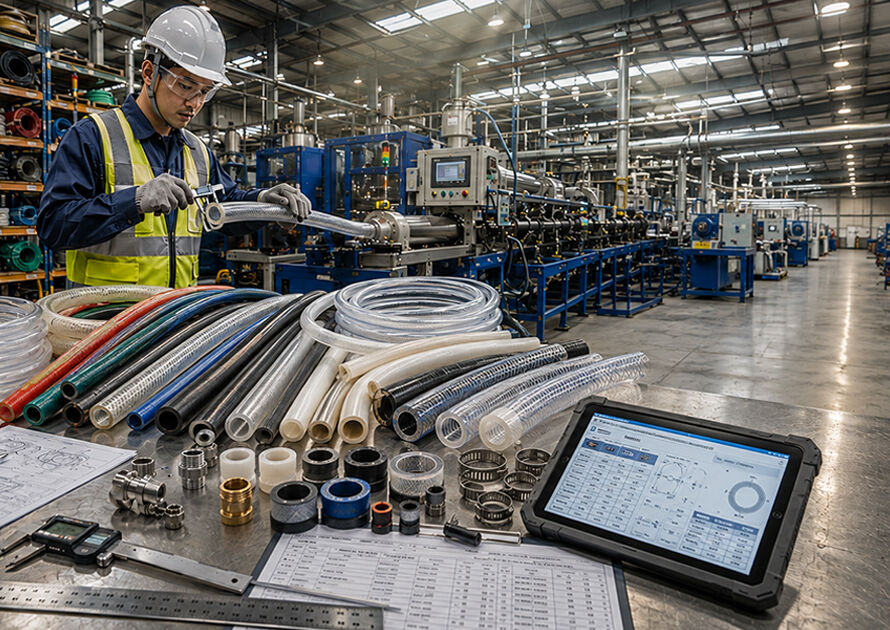
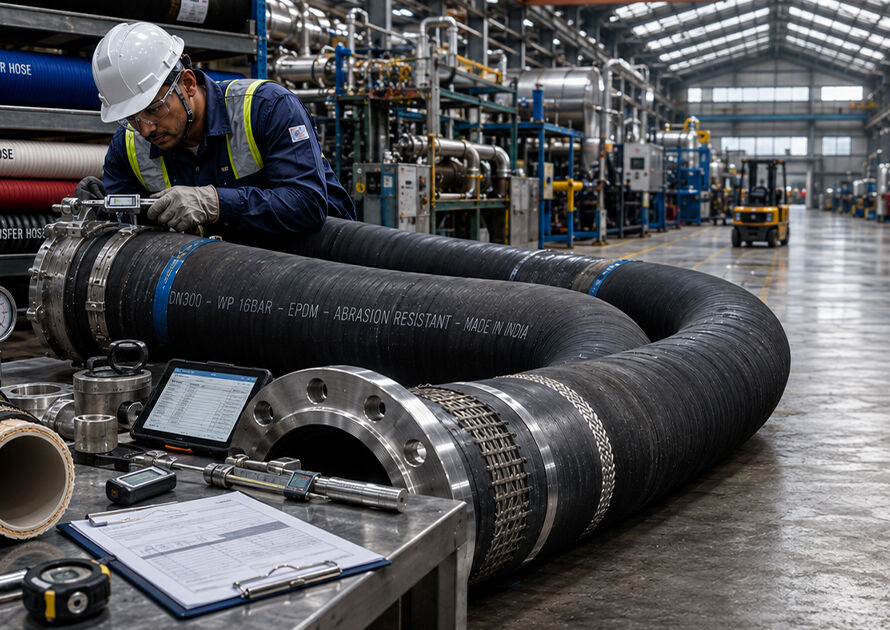
If you’re wondering what rubber tubing is used for, this guide walks through 10 of the most common industrial applications across key industries.
Rubber tubing is used to transfer liquids, gases, air, chemicals, and other media while providing flexibility, reliable sealing, and resistance to demanding operating conditions. From automotive manufacturing and food processing to chemical plants and medical equipment, it plays a critical role in keeping industrial systems operating safely and efficiently.
Compared to plastic or metal tubing, rubber tubing offers a better balance of flexibility, vibration absorption, and resistance to abrasion, weather, and mechanical stress. Depending on the rubber compound, it can also withstand exposure to oils, chemicals, heat, or outdoor environments, making it suitable for a wide range of industrial applications.
The following sections explore 10 of the most common rubber tubing uses, the industries that rely on them, and the key performance requirements that influence material selection.
Why Rubber Tubing Is Widely Used in Industrial Applications
The function of rubber tubing extends beyond transferring fluids or gases. Its combination of flexibility, durability, and material-specific performance makes it a reliable choice for a wide range of industrial applications. Selecting the right rubber compound helps ensure safe operation, longer service life, and consistent performance under demanding conditions.
Flexibility
Rubber tubing bends easily without compromising flow, making it suitable for compact equipment and complex routing. Its flexibility also helps absorb movement, vibration, and minor misalignment, reducing stress on connected components.
Chemical Resistance
Many rubber compounds are formulated to resist oils, chemicals, solvents, fuels, and cleaning agents. Choosing a tubing material that is compatible with the media being conveyed helps prevent degradation, contamination, and premature failure.
Temperature Resistance
Different elastomers are designed to perform across varying temperature ranges. For example, EPDM is commonly used for hot water and steam applications, while silicone performs well in both high- and low-temperature environments. Material selection should always match the operating conditions.
Pressure Handling
Industrial rubber tubing is available in a range of pressure ratings to suit different applications. Reinforced tubing, which incorporates textile or wire reinforcement, provides additional strength, improves burst resistance, and supports reliable performance in higher-pressure systems.
Abrasion & Weather Resistance
Industrial environments often expose tubing to abrasion, moisture, UV radiation, ozone, and changing weather conditions. Selecting a rubber compound with the appropriate resistance properties helps extend service life and maintain performance in demanding indoor and outdoor applications.
10 Common Industrial Applications for Rubber Tubing
Application 1: Automotive & Transportation Systems
Automotive systems rely on rubber tubing for fuel lines, breather tubes, coolant circulation, vacuum lines, and emissions control. Its flexibility allows it to route through confined engine compartments, while suitable rubber compounds withstand heat, vibration, and exposure to automotive fluids for reliable performance.
Application 2: Industrial Machinery & Manufacturing
Factories use rubber tubing for coolant and lubricant delivery, pneumatic air lines, and low-pressure process or drainage systems. Its flexibility simplifies installation and replacement, while vibration absorption helps protect connected equipment and maintain efficient operation. Many manufacturers also use custom industrial rubber products for applications with unique operating requirements.
Application 3: Food & Beverage Processing
Food-grade rubber tubing is used to transfer milk, juices, syrups, and other food products, as well as cleaning solutions used in clean-in-place (CIP) systems. Materials selected for these applications are designed to meet applicable food safety requirements, are easy to clean, and help preserve product quality by minimizing taste or odour transfer. Pure gum rubber tubing is commonly used in applications that require flexibility and product integrity.
Application 4: Medical, Pharmaceutical & Laboratory
Medical and laboratory environments use specialized rubber or silicone tubing for fluid transfer, peristaltic pumps, drainage systems, and laboratory equipment. Material selection is critical to ensure sterilization compatibility, chemical resistance, and product purity while reducing the risk of contamination.
Application 5: Agriculture & Irrigation
Rubber tubing supports drip irrigation systems, fertilizer and chemical dosing, sprayers, and small pumps. Tubing used outdoors should withstand UV exposure, changing weather conditions, and mechanical wear to deliver dependable performance throughout the growing season.
Application 6: Chemical Processing & Water Treatment
Chemical processing facilities and water treatment plants use rubber tubing to transfer treatment chemicals, acids, alkalis, and other process fluids. Because incompatible materials can swell, crack, or leak, compounds such as EPDM and FKM are selected based on the chemicals being handled and the operating environment.
Application 7: Power Generation & Utilities
Power plants and utility systems use rubber tubing for cooling water lines, flexible seals formed from spliced tubing, and protective sleeves over cables and electrical components. These applications require materials that provide dependable fluid handling, insulation, and resistance to heat and environmental exposure.
Application 8: HVAC, Refrigeration & Building Services
In HVAC and building systems, rubber tubing is commonly used for condensate drain lines, low-pressure water connections, and control or sensor tubing. Its flexibility simplifies installation in confined mechanical spaces while helping reduce vibration between connected equipment.
Application 9: Protection, Insulation & Cable Management
Not all rubber tubing uses involve transferring fluids. Rubber tubing is also used as protective sleeves for wires and cables, edge guards on metal panels, and insulating covers for components exposed to heat or electrical contact. These applications help improve equipment durability and reduce wear.
Application 10: Custom OEM & Specialty Applications
Many OEMs specify custom rubber tubing for specialized machinery, laboratory equipment, medical devices, instrumentation, and peristaltic pump systems. Manufacturers can tailor the tubing’s material, diameter, wall thickness, color, and markings to meet precise performance requirements. Working with an experienced custom rubber tubing manufacturer helps ensure the final product is designed for the intended application.
Factors That Influence Where Tubing Is Used
The answer to what rubber tubing is used for depends on the operating conditions of the application. Selecting the right tubing requires evaluating several factors to ensure safe, reliable, and long-lasting performance.
- Media type: The tubing must be compatible with the material being conveyed, whether it is water, air, oil, chemicals, food products, or other process fluids. Using an incompatible material can lead to degradation, contamination, or leaks.
- Temperature and pressure: Operating temperature and system pressure influence both the rubber compound and tubing construction. Higher-pressure applications may require reinforced tubing, while extreme temperatures call for materials designed to maintain their performance.
- Regulatory requirements: Applications in food processing, medical devices, pharmaceuticals, and potable water systems often require tubing that meets applicable industry standards for safety, hygiene, and product integrity.
- Operating environment: Exposure to UV radiation, weather, abrasion, moisture, or mechanical movement affects material selection. Choosing a compound suited to indoor or outdoor conditions helps maximize service life and reliability.
Because every industry operates under different conditions, there is no one-size-fits-all solution. Matching the tubing material and construction to the application’s specific requirements is essential for achieving safe and dependable performance.
FAQs
There is no single best material. The right choice depends on the application, operating temperature, pressure, and the media being conveyed. Common materials include EPDM, NBR, silicone, natural rubber, neoprene, and FKM, each offering different performance characteristics.
Rubber tubing is typically used for lower-pressure applications and smaller diameters, while rubber hoses are generally reinforced to handle higher pressures, vacuum conditions, and more demanding industrial environments.
Yes. Rubber tubing can be manufactured with custom materials, diameters, wall thicknesses, colours, hardness, and tolerances to meet the performance requirements of specific industries and OEM applications.
Rubber tubing is commonly selected for fluid transfer, air lines, instrumentation, and protective applications where flexibility is the priority. Rubber hoses are engineered with reinforcement layers for applications requiring higher pressure, greater mechanical strength, or heavy-duty material transfer.
Select tubing based on the media being conveyed, operating temperature, pressure, environmental conditions, flexibility requirements, and any applicable regulatory standards. Matching the material to the application helps improve safety, performance, and service life.
Regulatory requirements vary by application. For example, tubing used in food processing, medical devices, and potable water systems may need to comply with applicable industry standards and regulatory requirements based on the intended use.
Common industrial rubber compounds include natural rubber (NR), EPDM, nitrile (NBR), neoprene (CR), silicone, butyl, styrene-butadiene rubber (SBR), and fluoroelastomers (FKM). Each material is selected for its suitability to specific operating conditions and applications.
Key Takeaways
- Rubber tubing supports a wide range of industrial applications, from fluid transfer to protection and insulation.
- The right rubber compound should be selected based on the media, operating temperature, pressure, and environment.
- Matching tubing to application requirements improves safety, operational efficiency, and service life.
- Industry-specific requirements, including regulatory compliance, should always be considered during material selection.
- Working with an experienced manufacturer helps ensure the tubing meets your application’s performance needs.